


- October 1, 2026
- Posted by: Aurora Picco
- Category: Senza categoria
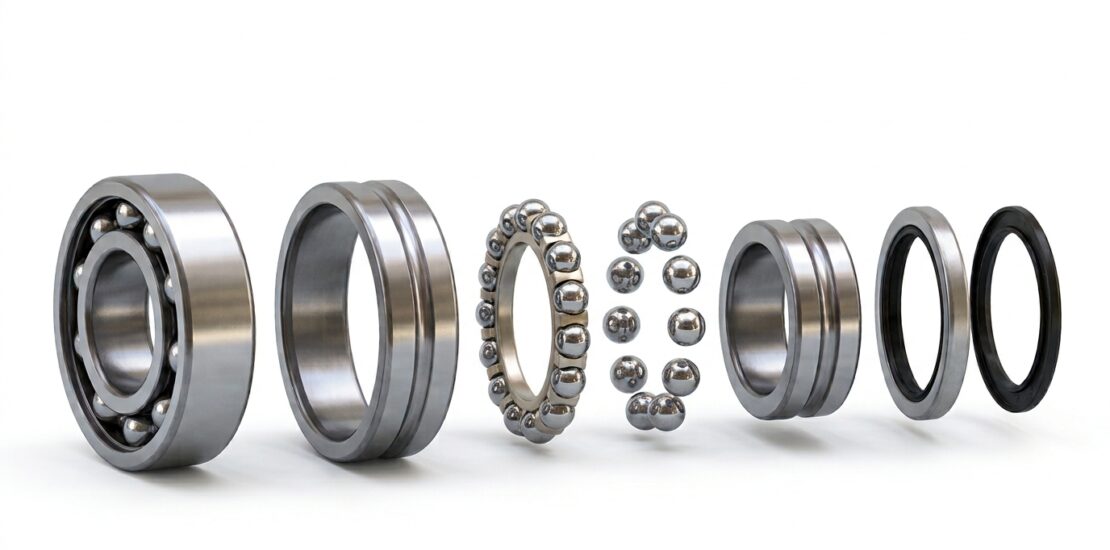
Finding the right component requires understanding the bearing process
Bearing components are precision products. Balls, rollers, cages, shields, rings and steel tubes may appear to be standardized products, but their actual performance depends on a complex combination of materials, manufacturing processes, tolerances, surface characteristics and inspection methods.
For this reason, sourcing bearing components should not be treated as a simple catalogue exercise. The key question is not: “Who manufactures this component?”
It is: “Which manufacturing process and supplier can provide the required component consistently for this specific application?”
A technical drawing establishes dimensions and tolerances. A material specification defines the required grade. However, the manufacturing process determines whether those requirements can be achieved consistently.
For example, two suppliers may manufacture a component to the same nominal specification while using different equipment, process controls and inspection systems. Their products may therefore behave differently in the customer’s production process. Technical sourcing begins by understanding these differences.
ICT’s component portfolio
ICT can support customers in sourcing and qualifying a wide range of bearing components, including:
- steel and ceramic balls;
- cylindrical and tapered rollers;
- cages and retainers;
- metallic and non-metallic shields;
- bearing rings;
- chrome steel tubes and related semi-finished products.
The company also works with specialized partners for grinding and diamond reprofiling technologies, assembly equipment and non-destructive testing. This broad scope allows ICT to look at the bearing supply chain from a process perspective rather than as a collection of unrelated products.
Not every supplier is appropriate for every application. A supplier may be highly competitive for standard industrial bearings but unsuitable for a demanding aerospace application. Another may have excellent precision capabilities but insufficient production capacity for a high-volume program. Technical sourcing therefore requires matching:
Customer requirements → Product specification → Manufacturing capability → Process stability → Production volume → Quality requirements
ICT helps customers make this connection.
ICT has developed a network of manufacturing partners across Europe and Asia. This provides customers with access to alternative sources while maintaining a technical approach to supplier selection. The objective is not to replace an existing supplier simply because another source is cheaper. Alternative sourcing can have many strategic objectives:
- reducing supply-chain dependency;
- increasing production capacity;
- improving competitiveness;
- securing a second source;
- accessing specialized technology;
- entering new markets;
- improving supply-chain resilience.
Before recommending a manufacturing partner for a specific application, ICT can evaluate the supplier through technical discussions, product and process audits, samples, testing and production validation. The qualification process may take months and, for critical applications, significantly longer. This is one of the fundamental differences between technical sourcing and conventional trading.
ICT does not replace the customer’s engineering or quality organization. Instead, it provides an additional technical resource. The customer defines the requirements and remains responsible for final approval. ICT contributes supplier knowledge, technical evaluation, international sourcing capabilities and local support. This creates a collaborative model in which sourcing decisions are based on technical evidence.
The value of a qualified supplier is realized over time. Once a manufacturing partner enters the supply chain, ICT can continue to support communication, technical follow-up and problem-solving between the customer and supplier. This is particularly valuable when the supplier is located in another country or when the product involves demanding technical requirements.
Every new supplier introduces a degree of uncertainty. The purpose of technical sourcing is to reduce that uncertainty before it becomes a production problem.
Through its technical approach and international network, ICT helps customers transform an open supplier market into a qualified and manageable supply base.
To get more information about ICT’s products and services, please get in touch with the company by writing to info@consulting-trading.com or calling at +39 0121 376811.